Greek national side
The Minister for the National Economy and the Governor of the Bank of Greece chose the designs for the euro coins from a set of proposals presented by a national technical and artistic committee. The designer of the winning motifs was sculptor Georges Stamatopoulos (his initials appear on each coin), sponsored by the Bank of Greece. There is a separate design for each denomination.
![]() Obverse - Reverse EUR 2 |
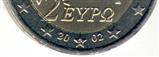
KM#: 188 Diameter (mm): 25.75 Thickness (mm): 2.20 Weight (g): 8.50 Shape: Round Colour: Outer part: white; inner part: yellow Issue date: 2002, 2003, 2004 (in blisters only), 2005, 2006 Composition: Outer part: copper-nickel; inner part: three layers: nickel brass, nickel, nickel brass Edge: Edge lettering, fine milled. Two varieties exist, that depend on the orientation of the lettering (Read putting the coin with the common face facing down):
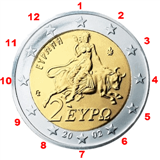
Description: Portrays a scene a scene from a mosaic in Sparta (third century AD), showing Europa being abducted by Zeus, who has taken the form of a bull. In Greek mythology Europa was a beautiful Phoenician princess, daughter of Agenor and Telephassa. Zeus saw her gathering flowers and immediately fell in love with her. Zeus transformed himself into a white bull and carried Europa away to the island of Crete. He then revealed his true identity and Europa became the first queen of Crete. Europa has lent her name to the continent of Europe, which is called Europa in all Germanic languages (except English), and in all Slavic languages which use the Latin alphabet, as well as in Greek and Latin.
* For more information please visit the mintmarked euros. |
||||||||||||||
![]() Obverse - Reverse EUR 1 |
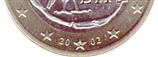
KM#: 187 Diameter (mm): 23.25 Thickness (mm): 2.33 Weight (g): 7.50 Shape: Round Colour: Outer part: yellow; inner part: white Issue date: 2002, 2003, 2004, 2005, 2006 Composition: Outer part: nickel brass; inner part: three layers: copper-nickel, nickel, copper-nickel Edge: Interrupted milled Designer: G.Stamatopoulos Description: Portrays an owl, symbol of goddess Athena, as it was depicted on an ancient Greek tetradrachm (5th century b.C.). Athena was patron of the crafts, wisdom and battle. She became the patron goddess of the city of Athens, in a competition with Poseidon. They agreed that each would give the Athenians one gift and the Athenians would choose whichever gift they preferred. Poseidon struck the ground with his trident and a spring sprung up; the water was salty and not very useful, whereas Athena offered them an olive tree. The Athenians (or their king, Cecrops) accepted the olive tree and along with it Athena as their patron, for the olive tree brought wood, oil and food.
* For more information please visit the mintmarked euros. |
||||||||||||||
![]() Obverse - Reverse 50 c |
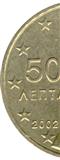
KM#: 186 Diameter (mm): 24.25 Thickness (mm): 2.38 Weight (g): 7.80 Shape: Round Colour: Yellow Issue date: 2002, 2003, 2004, 2005, 2006 Composition: Nordic gold Edge: Shaped edge with fine scallops Designer: N.Nikolaou Description: Eleytherios Venizelos (1864-1936), one of the most prominent political figures in Hellas. He was a pioneer in social reform, a renowned diplomat and played a key role in modernising the Greek state and the victorious military campaigns of 1912-1920, liberating Northern Greece and the Aegean islands. He was elected 7 times as the Prime Minister.
* For more information please visit the mintmarked euros. |
||||||||||||||
![]() Obverse - Reverse 20 c |
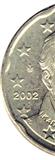
KM#: 185 Diameter (mm): 22.25 Thickness (mm): 2.14 Weight (g): 5.74 Shape: Spanish flower shape Colour: Yellow Issue date: 2002, 2003, 2004, 2005, 2006 Composition: Nordic gold Edge: Plain Designer: Ms M.Andonatou Description: Ioannis Kapodistrias (1776-1831), a distinguished national and European politician and diplomat, who became the first Governor of Hellas (1830-31) following the Greek War of Independence (1821-27). After taking charge of the final stage of the revolution and playing a decisive role in the ultimate victory, Ioannis Kapodistrias made notable contributions in such fields as domestic policy, education, justice, public works, social welfare, agriculture, stock breeding, trade and shipping.
* For more information please visit the mintmarked euros. |
||||||||||||||
![]() Obverse - Reverse 10 c |
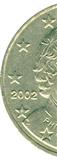
KM#: 184 Diameter (mm): 19.75 Thickness (mm): 1.93 Weight (g): 4.10 Shape: Round Colour: Yellow Issue date: 2002, 2003, 2004, 2005, 2006 Composition: Nordic gold Edge: Shaped edge with fine scallops Designer: P.Sotiriou Description: Rigas-Fereos (Velestinlis) (1757-1798) was a forerunner and leading figure of the Greek enlightenment and confederation. He was the first to visualize the liberation of the Balkans from the Ottoman Empire and was executed by the Ottomans in 1798 after vainly attempting to launch a Balkan-wide revolt against Ottoman rule.
* For more information please visit the mintmarked euros. |
||||||||||||||
![]() Obverse - Reverse 5 c |
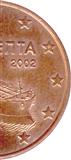
KM#: 183 Diameter (mm): 21.25 Thickness (mm): 1.67 Weight (g): 3.92 Shape: Round Colour: Red Issue date: 2002, 2003, 2004, 2005, 2006 Composition: Copper-covered steel Edge: Smooth Designer: Ms M.Andonatou Description: Portrays a contemporary tanker ship, a symbol of the maritine heritage of the country reflecting the innovative spirits of Greek shipping
* For more information please visit the mintmarked euros. | ||||||||||||||
![]() Obverse - Reverse 2 c |
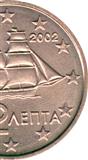
KM#: 182 Diameter (mm): 18.75 Thickness (mm): 1.67 Weight (g): 3.06 Shape: Round Colour: Red Issue date: 2002, 2003, 2004, 2005, 2006 Composition: Copper-covered steel Edge: Smooth with a groove Designer: Ms A.Michelioudaki and N.Nikolaou Description: Portrays a corvette, a type of ship used during the Hellenic liberation fight (1821-1827). A corvette is a small, maneuverable, lightly-armed warship, smaller than a frigate. When referring to sailing ships, a corvette is a ship-rigged sloop. Almost all modern navies use ships smaller than frigates for coastal duty, but not all of them use the term "corvette."
* For more information please visit the mintmarked euros. |
||||||||||||||
![]() Obverse - Reverse 1 c |
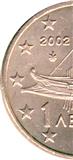
KM#: 181 Diameter (mm): 16.25 Thickness (mm): 1.67 Weight (g): 2.30 Shape: Round Colour: Red Issue date: 2002, 2003, 2004, 2005, 2006 Composition: Copper covered steel Edge: Smooth Designer: Ms A.Michelioudaki Description: Portrays an advanced model of an ancient Athenian triere (or trireme), the largest battle ship for 200 years, dating from the time of the Athenian democracy and Kimon (5th century b.C.- Marine Museum). Triremes were the dominant warship in the Mediterranean from around 700 to 300 BC, when naval combat took place mainly by ramming enemy vessels which would typically break apart from the force of the collision. In order for this to work well, the boats need to be both fast and maneuverable, which means they ought to have a large number of rowers but still remain as thin and short as possible. Triremes were equipped with sails, which were taken down before battles, but cramped conditions made them unsuited for long-distance travel.
* For more information please visit the mintmarked euros. |
Nordic gold: 89% copper + 5% aluminium + 5% zinc + 1% stain