Greek euros with mintmarks
On January 1, 1999 eleven European member states adopted the euro as their formal
currency and started producing the required coins and banknotes in order to replace their national
currencies by January 1, 2002. The only member state that did not meet the economic criteria to
join the new european currency was Greece. Following a delay of exactly two years, Greece was also
accepted into the Eurozone by the European Council's Decision of June 19, 2000.
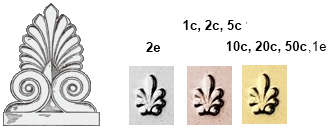
Mintmarks on Greek coins
- Anthemion flower: Quality symbol of the Greek Mint
- "S": Finland (Suomi) on the 1 and 2 euro coins
- "E": Spain (Espana) on the 20 cent coins
- "F": France on the 1, 2, 5, 10 and 50 cent coins
Because of the delay, however, it became impossible for the
Hellenic Mint to produce 1300 million euro coins in time for the
January 1, 2002 changeover to the new currency. The officials
decided to order 500 million coins from abroad (Spain, Finland and France) and these coins feature
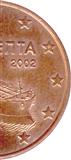
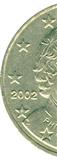
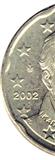
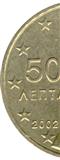
two different mintmarks: the anthemion flower, which can be found on all the Greek modern coins
and a small letter indicating the mint in which the coin was struck.
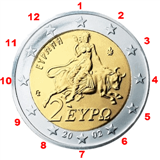 Numbered stars
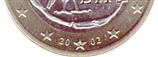
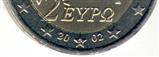
The lettered mintmarks can be found in different positions on each coin, but always inside a star close to the date.
- Mintmark "S" can be found inside star No7
- Mintmark "F" can be found inside star No3, No9, No11
- Mintmark "E" can be found inside star No9
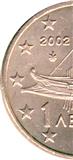
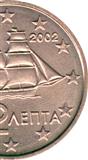
| 1 cent "F" |
2 cents "F" |
5 cent "F" |
10 cents "F" |
20 cents "E" |
50 cents "F" |
1 euro "S" |
 |
 |
 |
 |
 |
 |
 |
| 2 euros "S" |
 |
The Historical Use of Mint Marks
A mint mark is an inscription on a coin indicating the mint where the coin was produced. Mint marks were first developed to locate a
problem. If a coin was underweight, or overweight, the mint mark would immediately tell where the coin was minted, and the problem
could be located and fixed. Another problem which could occur would be a dishonest mint official debasing the coin, or putting less
precious metal in the coin than specified.
The use of mint marks on coins dates all the way back to the ancient Greeks. They called them "Magistrate Marks" because they
referred to the magistrate in charge of producing that coin. If there was a problem with a coin, they would know which magistrate
was in charge of its production. Some common problems at the time could have been a coin being overweight or underweight. Debasing
a coin (putting less precious metal), or otherwise tampering with it, was a very serious crime, often punishable by death in many
civilizations. For example, in 1649, the directors of the Spanish colonial American Mint at Potosi, in what is today Bolivia, were
condemned to death for seriously debasing the coinage.