Athens 2004 - Series B coins
In August 2004, the Olympic Games returned to the country where they were born over 2,500 years ago, and to
Athens the city of their revival in 1896. Within the framework of the Olympic Coin Program, the Greek Mint
issued a series of commemorative coins, Gold and Silver, on which Greek history and heritage were engraved.
The total collection includes 18 coins (6 Gold and 12 Silver) which were released in 6 quarterly issues, each
consisting of 1 Gold and 2 Silver coins. The themes were selected by the Minister for the National Economy and
the Governor of the Bank of Greece, from a set of proposals presented
by a national technical and artistic committee.
|
Series A | Series B | Series C |
Series D | Series E | Series F |
Torch Relay |
| Issue date |
3.3.2003 |
2.6.2003 |
1.9.2003 |
3.11.2003 |
1.4.2004 |
31.5.2004 |
2004 |
The second series of the Official Coins of the ATHENS 2004 Olympic Games was issued on June 2, 2003. The
coins can be purchased individually, in sets of two silver coins and a complete set including all three
coins, the gold and the two silver ones. The collection will be completed with 4 more series.
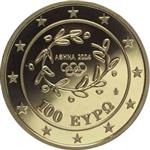
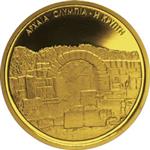
ItemMerchantDescription: The enchanting setting of ancient Olympia was chosen by the ancient Greeks
as the place where the most glorious and renowned pan-Hellenic games in antiquity were held, which gave
birth to the modern Olympic Games. The entire area of Olympia is occupied by temples, altars, gymnasia and
stadia, porticoes and guest houses, the treasuries of the various Greek cities and a great number of
statues. The first games in Olympia are believed to have been held in 776 B.C., a date that thereafter
constituted the basis for the calculation of time in antiquity. They were initially local games, which
later became Peloponnesian and finally pan-Hellenic. Thus, they acquired an official character, since
while in progress a military truce was declared and any hostilities between rival Greek cities ceased.
One of the most important monuments of Olympia, pictured on the second Gold coin, is the
Crypt, a long and narrow vaulted passage through which the athletes and judges entered the Stadium, and
which soon acquired its symbolic importance signifying the opening of the games.
ItemMerchantDescription: Long jump is also one of the classical track events, drawing its roots from
ancient times. In antiquity only the long jump without momentum existed, where the athlete had to hold a
jumpingweight in each hand, which he swung vigorously to help him achieve momentum, and then dropped
behind him before landing. The men's long jump was on the programme of the Athens Olympic Games in 1896,
and the women's on the programme of the 1948 Olympic Games in London. In its modern version it assumes 4
forms (simple jump - triple jump - long jump - pole vault). The theme protrays a modern athlete at the
moment he is touching the ground, while the ancient athlete in the backround is shown while starting off
his jump, as he is seen on a black-figure vase of the 5th century B.C.
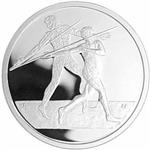
ItemMerchantDescription: The modern event continues an ancient tradition. The javelin was on the
programme of the ancient Olympic Games as one of the pentathlon sports and took on two forms: a) throwing
the javelin for distance and b) throwing the javelin at a target, in an event that may be likened to
shooting today, and which was performed by athletes on foot or on horseback. The difference between the
ancient and the modern javelin is the use in antiquity of a thong, a strap forming a loop and held by the
athlete with his index and middle fingers. Today, the javelin is carried along a corridor 30 to 36.5 m long
and 4 m wide, at the end of which there is an arc-shaped line to define the throwing line. The event was
introduced at the 1908 Olympic Games in London, and Los Angeles Olympic Games of 1932, for men and women
respectively. In the composition a modern athlete figure appears in the foreground, running towards the
starting point of the throw, and an ancient athlete in the position of preparation for the throw, as he is
depicted on a 5th century representation.