Athens 2004 - Series D coins
In August 2004, the Olympic Games returned to the country where they were born over 2,500 years ago, and to
Athens the city of their revival in 1896. Within the framework of the Olympic Coin Program, the Greek Mint
issued a series of commemorative coins, Gold and Silver, on which Greek history and heritage were engraved.
The total collection includes 18 coins (6 Gold and 12 Silver) which were released in 6 quarterly issues, each
consisting of 1 Gold and 2 Silver coins. The themes were selected by the Minister for the National Economy and
the Governor of the Bank of Greece, from a set of proposals presented
by a national technical and artistic committee.
|
Series A | Series B | Series C |
Series D | Series E | Series F |
Torch Relay |
| Issue date |
3.3.2003 |
2.6.2003 |
1.9.2003 |
3.11.2003 |
1.4.2004 |
31.5.2004 |
2004 |
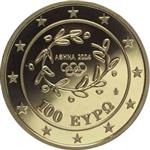
The forth series of the Official Coins of the ATHENS 2004 Olympic Games was issued on November 3, 2003.
The coins can be purchased individually, in sets of two silver coins and a complete set including all
three coins, the gold and the two silver ones. The collection will be completed with 2 more series.
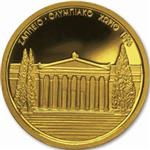
ItemMerchantDescription: Zappeion is an Athenian mansion built at the expense of the Greek public
benefactor Evangelos Zappas (1800 - 1865) to serve as the venue for Greek artistic, agricultural and
industrial fairs. Harilaos Trikoupis later (1887) decided to move elsewhere the Protestant cemetery that
was situated there and to create a garden around the building. The Zappeion, designed by the architect
Theophilos Hansen, was built between 1874 and 1888. It was originally given the name 'Olympia' and acquired
its present name after the death of the two brothers Evangelos and Konstantinos Zappas, whose busts –
created by the well-known Greek sculptors I. Kossos and G. Vroutos respectively – stand at the entrance of
the building. Zappeion, which is the subject of the fourth gold coin, is related to the first Olympic Games
in Athens in 1896, since at that time, the lack of a necessary Infrastructure and the accommondation
facilities for the participants, required the use of the mansion as an "Olympic village" for the Games and
also to host certain games, such as fencing.
ItemMerchantDescription: Rhythmic Gymnastics is one of the oldest sports in the world. In ancient
Greece, three distinct programmes of gymnastic exercise were developed: one for the maintenance of good
physical condition, another for military training, and a third as part of the conditioning regimen for
athletes. Modern rhythmic gymnastics were developed in the late 1950s. In this sport for females only,
disciplines are characterized by the use of accessories such as a ball, clubs, hoop and rope, and ribbons,
to the accompaniment of music. The composition on the coin represents a young woman holding a multicoloured
ribbon, executing a graceful figure, while in the background, two female athletes from antiquity execute a
series of acrobatic figures, the scene was taken from a terracotta in Lower Italy.
ItemMerchantDescription: Swimming was highly esteemed in ancient Greece and Rome, as shown on vases and
wall paintings dating back to 1,600 B.C., especially as a form of training for warriors. In modern times
competitive swimming was instituted in Great Britain at the end of the 18th century and the first modern
Olympic Games, held in Athens, Greece, in 1896, included swimming races. On the coin a woman swimmer is
depicted, preparing to dive from the diving-board, while in the background another woman athlete is just
about to dive into the water, a scene from an Archaic bronze statuette.