How can you tell if they are genuine?
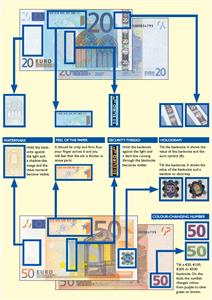
The euro is the single currency for a large group of countries in the European union, known as the euro area. Over
300 million people in the euro area use euro banknotes and coins for their cash payments. Moreover, between 10% and 20%
of euro banknotes in circulation, in titles of value, are used outside the euro area. Inevitably, the currency's
importance and high international profile make it attractive for counterfeiters. Although this threat has been
contained, with high-tech security features making euro banknotes secure and easy to distinguish from counterfeits,
vigilance is necessary to discourage counterfeiting, professional cash handlers in banks, retail companies, restaurants
and in other businesses where large amounts of cash are handled have to be familiar with euro banknotes and coins.
We all know that modern reproduction technology is capable of making good copies of any printed material. Nothing will
stop the professional counterfeiter from trying, but our new banknotes contain a combination of security features, which
will make it very difficult, if not impossible. Many have been used on the national currencies of EU Member States before.
They have all now been skilfully incorporated into the euro coins and banknotes. The result is a series which is one of the
most complex and difficult to counterfeit.
In addition to technical specifications for security reasons, a whole network has been set up at eurozone level, but
also at national level for the prevention of counterfeiting attempts. The Counterfeit Monitoring System (CMS), established
by the European Central Bank, in co-operation with the national Central Banks of the Eurosystem, has a Counterfeit Currency
Database for the storage and processing of data relating to counterfeit euro banknotes and coins. At central level, two
analysis centres have been established, the Counterfeit Analysis Centre (CAC) in Germany for banknote counterfeits and
the European Technical and Scientific Centre (ETSC) in France for coin counterfeits. At national level, the Central Bank
of each member state of the eurozone operates as a National Counterfeit Centre (NCC). The National Analysis Centres for
banknotes and coins - NAC and CNAC - also operate at a national level.
Banknote security features
Several security features have been incorporated into the euro banknotes so that, upon careful examination, the
authenticity of the banknotes can be reliably detitleined.
| Feel | Look | Tilt |
|---|
 |
 |
 |
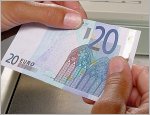
| Feel the "raised" print - the special printing processes give banknotes their unique feel. The initials of the European
Central Bank, the value numerals and the motifs of windows and gateways will feel rough to the touch. Be aware that age
and wear can negate some of these properties. |
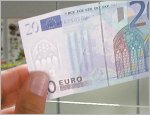
Look at the banknote and hold it up to the light: the watermark, the security thread and the see-through register will
All three features can be seen from the front and the reverse side of genuine banknotes. |
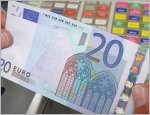
Tilt the banknote: on the front of the banknote, you can see the shifting image on the hologram foil stripe (on the
low-value banknotes) or the hologram foil patch (on the high-value banknotes). On the reverse side, if you tilt the
banknote, you can see the brilliance of the iridescent stripe (on the low-value banknotes) or the colour-shifting
ink (on the high-value banknotes) |
A series of security features have been incorporated into the euro banknotes so that, upon careful examination,
the authenticity of the banknotes can be reliably detitleined. The banknotes contain the following security features:
- Intaglio printing
- watermarks
- Security thread
- See-through register
- Special foil/special foil elements
- Iridicent stripe / shifting colours.
The euro banknotes are printed on 100% cotton paper which differs substantially
from normal paper. By using a special printing technique, several picture elements on the front of the banknote are
identifiable by touch. The guidelines on detecting counterfeit currency give a comparison of genuine and falsified
security features.
| Banknote paper | Raised print | watermark |
|---|
 |
 |
 |
| The see-through register is a feature found in the upper left-hand corner on the front of the banknote. Irregular shapes
printed on the front and back of the euro banknotes form a complete value numeral when held up to the light. |
Intaglio printing is used to apply a tactile relief to the front of the banknotes; the abbreviations of the European
Central Bank in the various national languages (BCE, ECB, EZB, EKT, EKP), the value numeral and the pictures of the
windows and gateways are identifiable by touch. At the edge on the front of the €200 and €500 notes several
distinctive features have been printed, primarily to make it easier for the visually impaired to recognise the banknotes.
The euro banknotes are also printed on special paper with a destinctive surface texture. Please note, however, that
through age and general wear and tear, some of these properties may be partly or completely lost. |
If a banknote is held up to the light, the watermark appears on both sides of the non-printed area. Both the predominant
architectural motif (multitone watermark) and the value numeral (wire watermark) can be seen. The watermark is put into
the paper by varying the paper thickness as the paper is manufactured. This can be seen in several areas, some of which
are lighter and others darker than the surrounding paper. |
| Security thread | Iridescent stripe/shifting colours | Special foil elements |
|---|
 |



|


|
| The euro banknotes contains a security thread which is embedded into the paper near the middle of the note and is visible
when held up to the light. A dark line runs from top to bottom of the banknote. If one looks more closely at the thread against
the light, the word EURO and the value numeral (alternatively legible and mirror-reversed) appear. |
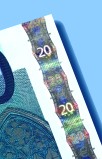
In addition to the special foils, there is a second difference between the small-denomination euro notes and the
large-denomination notes. If you look at the reverse of the €5, €10 and €20 banknotes, you will
see an iridescent stripe next to the security thread. The stripe varies in colour from light yellow to gold yellow
when the note is tilted near a good light source and also reveals the euro symbol and value numeral (5, 10 and 20).
The €50, €100, €200 and €500 banknotes contain an optical-variable colour element. Depending on the
viewing angle, the value numeral in the lower right-hand corner on the reverse of these four notes changes colour from
reddish-purple to olive-green or brown. |
When the banknote is tilted, either the euro symbol or the value numeral (5, 10 or 20) - depending on the viewing angle
- appears as a hologram with shifting colours on €5, €10 and €20, or either the value numeral or the
architectural motif - depending on the viewing angle - appears as a hologram with shifting colours on
(€50, €100, €200 and €500). When held up to the light, a closer look at the foil stripe reveals a euro
symbol in the foil perforations. |
| Micro Lettering | Ultra-violet properties (fibres and ink) |
|---|
|
|
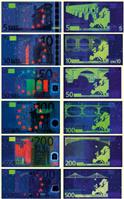
| Under ultra-violet light check the following characteristics:
- The paper does not become fluorescent, i.e. it emits no light and is "UV dull".
- The fibres embedded in the paper are fluorescent and are visible in three colours (red, blue and green).
- On the front of the banknote, two inks become visible: the blue ink becomes green and the yellow ink becomes orange.
The European flag and the signature of the ECB President are
green and the stars are orange. Other features on the front of the banknote will also be visible; however, this will vary
between the different denominations.
- On the reverse side, only one ink will be visible. The map of Europe, the bridge and the denomination appear in yellow.
|
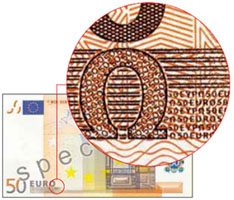
Under a magnifying glass you can see tiny writing on some areas of the banknote. The texts are perfectly legible;
however, some of them do differ in size. For example, the 0.8 mm small print can, in
the majority of cases, be read by the naked eye. The 0.2 mm micro printing, on the
other hand, simply appears as a thin line to the naked eye, but you can read the lettering with the aid of a magnifying
glass. The smallest print on an authentic banknote should be sharp and not blurred.
|